The difference in one line
An estimate is your best approximation of what a job will cost, based on what you know now. A quote is a fixed price for a clearly defined scope, which you stand by if the customer accepts it within a set period.
Customers often use the words interchangeably, and so do plenty of trades. What matters is what the document says. A “quote” with vague work invites the same arguments as a loose estimate, and an estimate with a tight scope and a stated cap behaves a lot like a quote.
Estimate vs quote compared
| Estimate | Quote | |
|---|---|---|
| Price | Approximate | Fixed for the stated scope |
| Best when | You can’t see the whole job yet | The work is clearly defined |
| If the job grows | You revise it and ask for approval | Extra work is priced separately |
| How long it holds | Often short, since costs move | A stated period, such as 30 days |
| What the customer sees | A budget guide | A price they can hold you to |
When an estimate is the better choice
Use an estimate when the real cost depends on what you find. A plumber pricing a leak inside a wall, a cleaner pricing a move-out without seeing the oven, and a developer pricing a feature that touches someone else’s system all have the same problem. An estimate gives the customer a number without promising one you can’t keep.
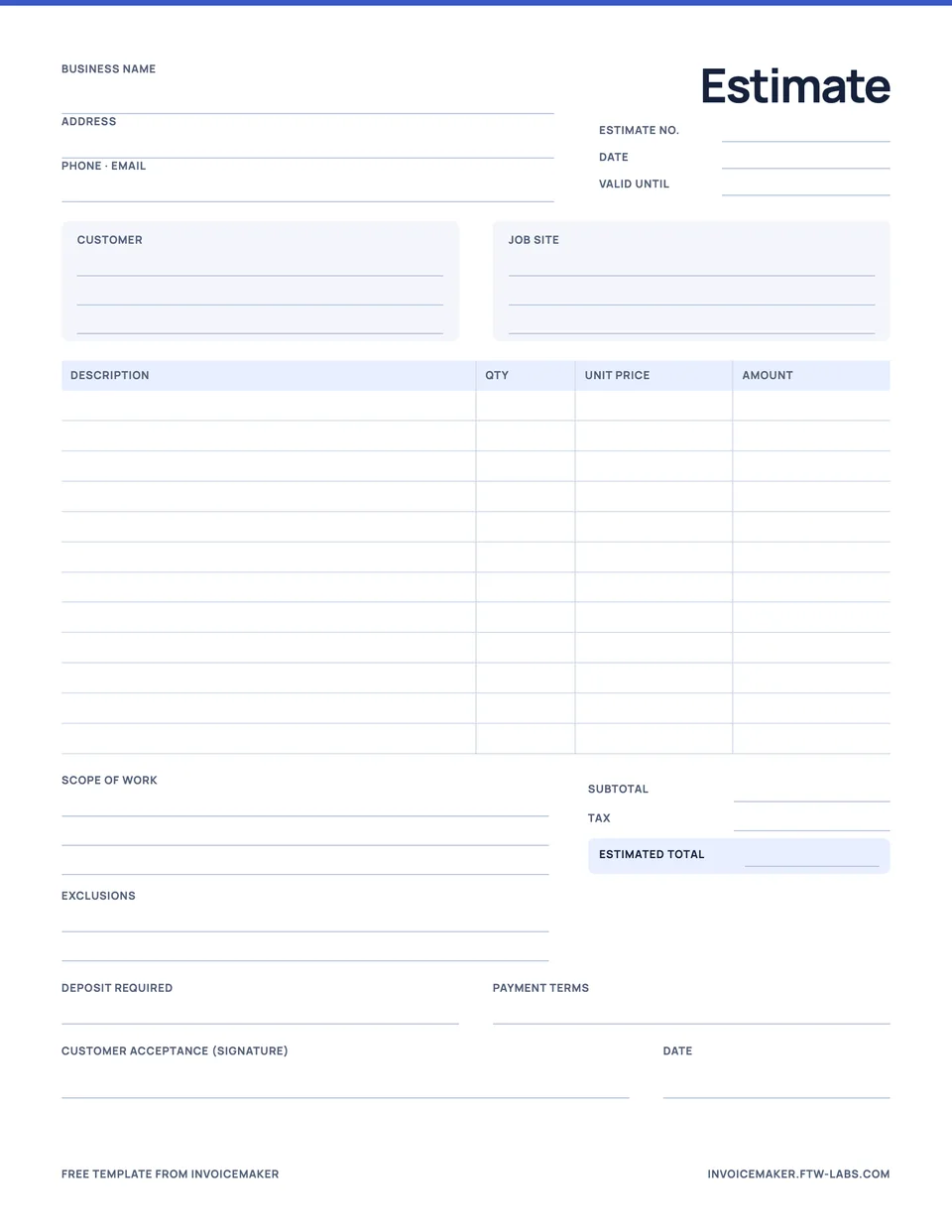
Make it useful by showing how you got there: hours at your rate, materials, and the assumptions behind them. If the customer needs a ceiling, give a range or a cap, for example “estimated 6 to 8 hours; we’ll check with you before going past 8.”
When to send a quote instead
Send a quote when you can define the work precisely and you trust your costs. Customers comparing three businesses tend to prefer quotes because they are easy to compare, so a quote can win the job. The risk is yours, though: if you priced it too low, you still do the work for that price.
A good quote lists what’s included, what isn’t, how long the price holds, and what happens if the customer asks for more. “Paint living room walls, two coats, customer supplies paint, ceilings and trim excluded, price valid until 30 November” leaves very little to argue about.
How to word either one so it holds up
- Use an honest title. If the price can move, call it an estimate.
- Describe the scope in specifics. Rooms, square footage, deliverables, number of revisions.
- List the exclusions. Whatever a customer might assume is included and isn’t.
- Show the arithmetic. Quantity and rate for each line, then the total.
- Add a valid-until date. Material prices and your calendar both change.
- Say how changes are handled. For example, “extra work is priced and approved before it starts.”
- Get acceptance in writing. A signature or a reply email is enough.
What about bids and proposals?
A bid is a price submitted in competition, common for construction projects and public contracts with set requirements. A proposal adds context around the price: your approach, a timeline, and sometimes options at different budgets. For most small service jobs, an estimate or a quote is all the customer is asking for.
Whether any of these documents is binding depends on what you and the customer agreed and on the rules where you work. The wording above makes the agreement clear; it doesn’t replace a contract when a job needs one.
From accepted price to invoice
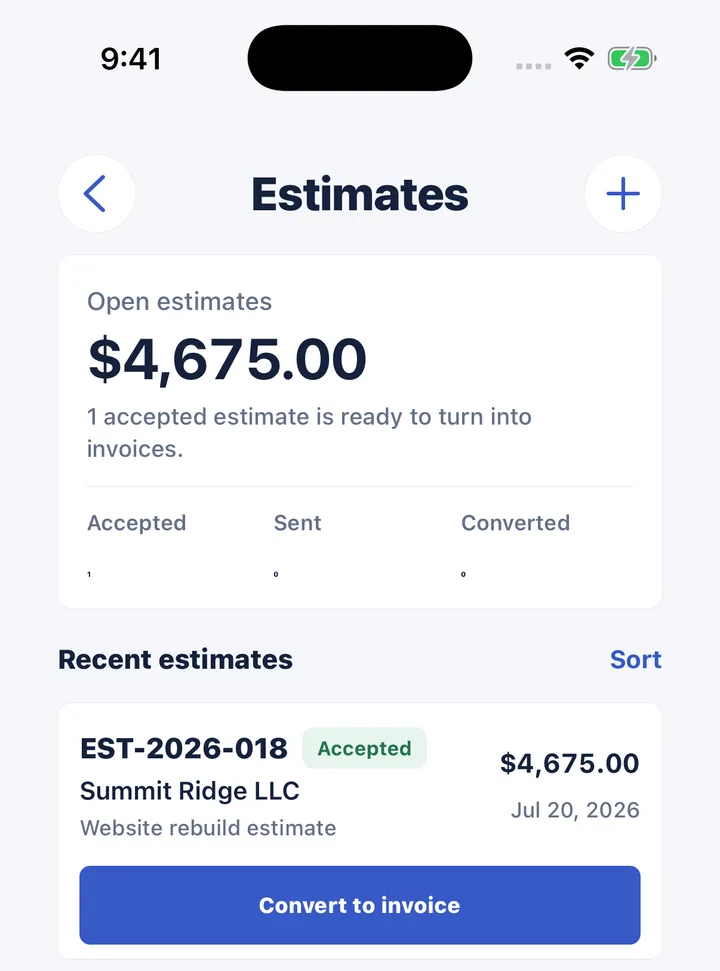
Once the customer says yes, the estimate or quote becomes the reference for your invoice. InvoiceMaker has invoices, estimates and receipts rather than a separate quote type, so for a fixed-price quote, create an estimate and state in the notes that the price is fixed for the listed scope until a date. When it’s accepted, tap Convert to invoice and the client and line items carry over.
For a full worked example, read how to write an estimate, or start from the printable estimate template.
Questions
Can I charge more than my estimate?
Only if the customer agrees. When the work turns out bigger than estimated, stop, explain what changed and the new price, and get approval in writing before you continue. Local consumer rules may also limit how far a final bill can exceed an estimate.
Is a bid the same as a quote?
A bid is a quote submitted in competition, usually for a larger project or a tender with set requirements. For everyday service jobs, customers asking for a bid usually just want your fixed price.