What’s on this estimate template
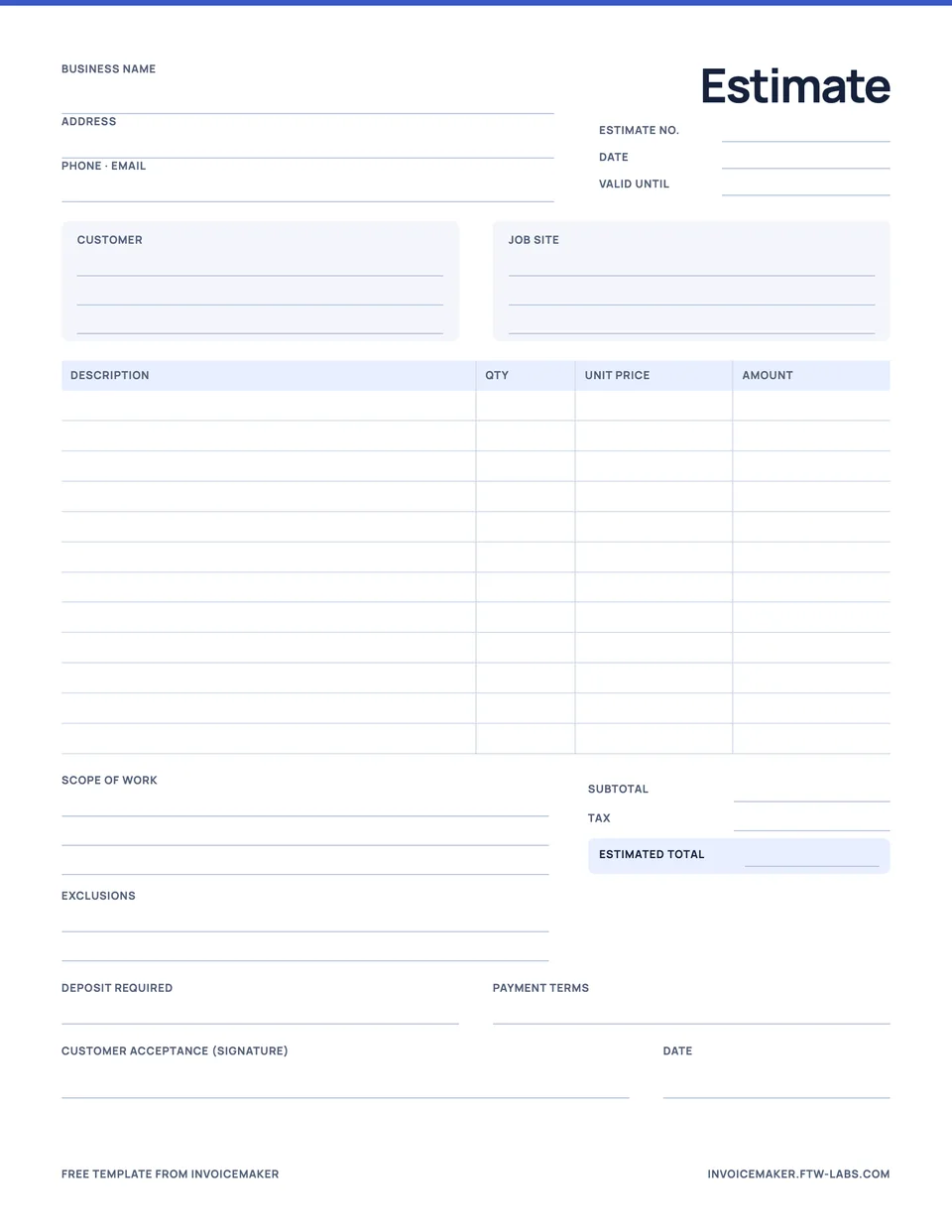
The PDF is a one-page, US letter estimate form you can print and fill in by hand. It has room for everything a customer needs to say yes:
- Your business details, an estimate number, the date and a valid-until date.
- The customer’s name and contact details, plus the job site address.
- Twelve line items with description, quantity, unit price and amount columns.
- Subtotal, tax and estimated total.
- A scope box for what’s included and an exclusions box for what isn’t.
- Deposit and payment terms.
- A customer acceptance line with signature and date.
Work estimate example
This is the template filled in for a kitchen backsplash job. The amounts are illustrative, with no tax.
| Description | Qty | Amount |
|---|---|---|
| Remove old backsplash | 3 h × $60 | $180.00 |
| Tile installation | 30 sq ft × $18 | $540.00 |
| Tiles and adhesive | 1 × $310 | $310.00 |
| Grout, sealing and cleanup | 2 h × $60 | $120.00 |
Scope: backsplash behind sink and stove only. Outlets moved by others. If damaged drywall is found, we will price the repair before continuing.
The scope note does the heavy lifting. It limits the job to two walls, names work that someone else is doing, and says what happens if the drywall underneath turns out to be damaged. A customer reading it knows exactly what $1,150 buys.
How to fill in the estimate template
- Number and date it. Use your next estimate number and a valid-until date, usually 30 days out.
- Add the customer and job site. The job site matters when the billing address is somewhere else.
- List the work line by line. Keep labor and materials on separate lines with a quantity and price for each.
- Total it. Add the lines, then any tax, and write the estimated total.
- Write the scope and exclusions. Be specific about rooms, surfaces, deliverables and anything you won’t do.
- Get it signed. Ask the customer to sign and date the acceptance line before you book the work.
Tips for estimates that win the job
- Send it quickly. An estimate that arrives the same day often beats a cheaper one that takes a week.
- Show your working. Hours at a rate are easier to accept than a round number.
- Offer an option. A basic and a fuller version let the customer choose instead of shopping around.
- Follow up once. A short message a few days later answers questions the customer didn’t ask.
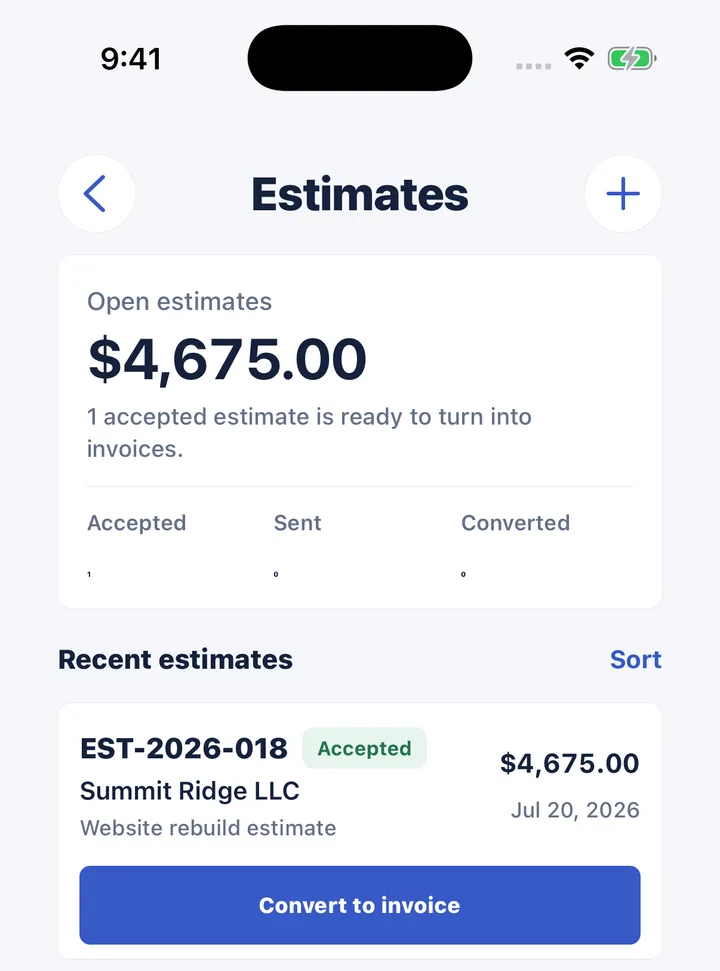
For a full walkthrough, read how to write an estimate. Not sure whether to promise a fixed price? See estimate vs quote. If you’d rather type than write, the estimate maker builds the same document on your phone and converts it into an invoice when the customer accepts.
Questions
Can I turn this estimate into an invoice later?
On paper you’d copy the accepted lines onto an invoice form. In InvoiceMaker, mark the estimate accepted and tap Convert to invoice, and the client and line items carry over.
What is a work estimate?
A work estimate is an estimate for labor and the materials needed to do a job, as opposed to a price list for goods. It breaks the job into tasks so the customer can see where the money goes.