What payment terms are
Payment terms are the conditions on an invoice that say when payment is due, how the customer can pay, and what happens if they pay early or late. At minimum they need a due date. “Payment due within 14 days” is a term; printing “Due 20 October 2026” next to the total turns it into a date nobody has to work out.
Agree on terms before the work starts, ideally in your estimate or contract. Terms that first appear on the invoice can surprise a customer, and surprised customers pay slowly.
Common invoice payment terms and what they mean
| Term | What it means | Often used for |
|---|---|---|
| Due on receipt | Pay as soon as the invoice arrives | One-off jobs, new customers, small amounts |
| Net 7 | Due 7 days after the invoice date | Small service jobs |
| Net 14 | Due 14 days after the invoice date | Regular clients, freelancers |
| Net 30 | Due 30 days after the invoice date | Business clients with an accounts team |
| Net 60 / Net 90 | Due 60 or 90 days after the invoice date | Large companies; check you can wait that long |
| EOM | Due at the end of the month the invoice is dated | Customers who pay suppliers in one monthly batch |
| 2/10 Net 30 | 2% off if paid within 10 days, otherwise the full amount in 30 | Encouraging early payment |
| 50% upfront | Half before work starts, the rest on completion | Bigger jobs with material costs |
How to calculate an invoice due date
Count from the invoice date, not the day the work finished. An invoice dated 6 October 2026 on Net 30 terms is due on 5 November 2026. Print that date on the invoice rather than leaving the customer to count. The Net 30 guide has more worked dates, including the February trap.
If you send the invoice a week late, the customer pays a week late too. Sending it the day the job ends is the cheapest way to get paid sooner.
Payment terms wording examples
Copy and adapt these. Replace the dates, amounts and reference with your own.
Net terms with a date
“Payment is due within 14 days of the invoice date, by 20 October 2026.”
Due on receipt with payment details
“Payment due on receipt. Bank details are below; please use INV-118 as the reference.”
Deposit and balance
“A 50% deposit of $600 is due before work begins. The remaining $600 is due on completion.”
Early payment discount
“Pay in full within 10 days and take 2% off the total.”
Late fee
“Balances unpaid 30 days after the due date are charged 1.5% per month.”
Late fees only work if the customer agreed to them before the job, and some states cap how much you can charge, so check the rules where you work before adding one.
Terms that get invoices paid faster
- Shorter terms for small jobs. Nobody needs 30 days to pay $180.
- A real date. “Due 20 October” beats “Net 14” on its own.
- More than one way to pay. List bank transfer and at least one other method.
- A deposit on large jobs. It covers materials and confirms the customer is committed.
- A polite follow-up the day after the due date. Most late invoices are forgotten rather than disputed.
Setting payment terms in InvoiceMaker
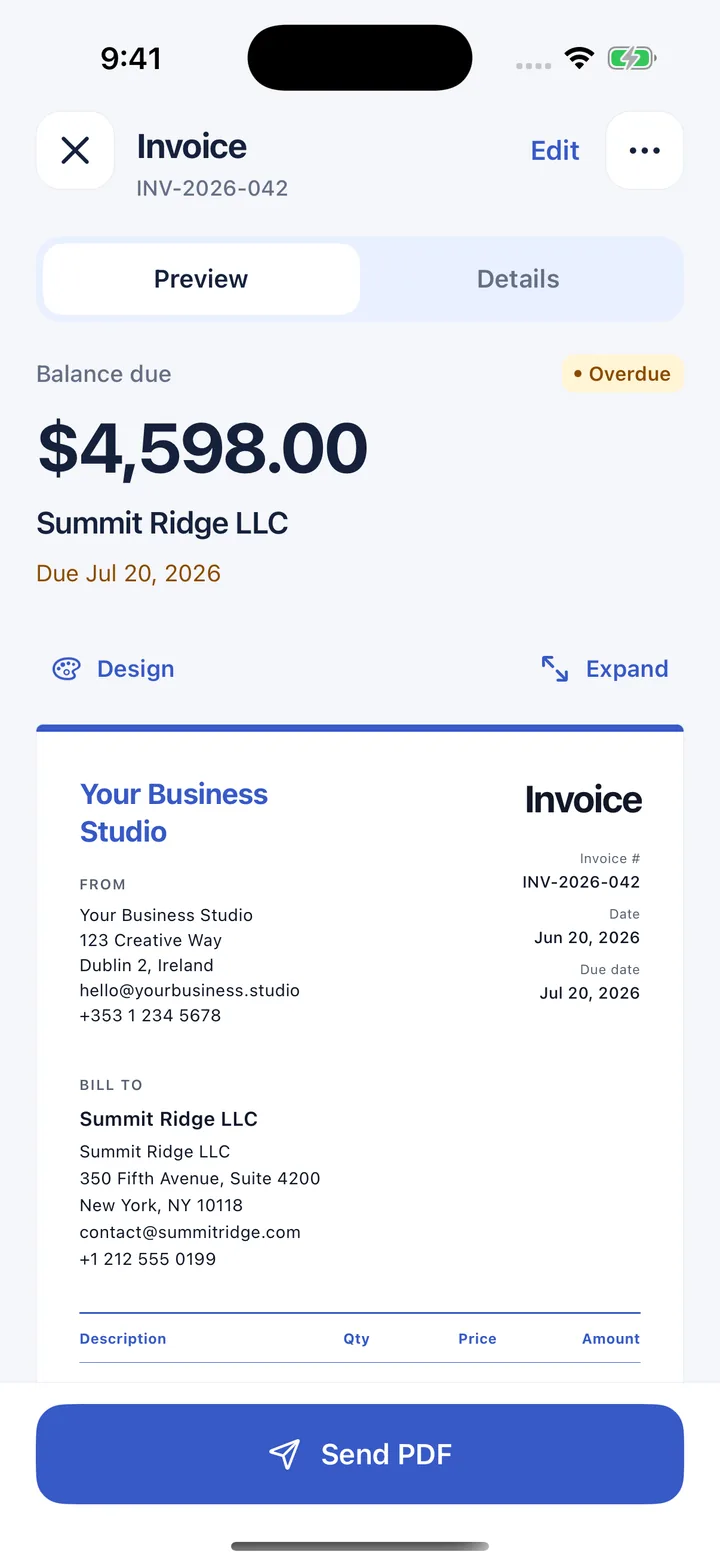
When you create an invoice, choose a saved term (Due on receipt, Net 7, Net 14 or Net 30) or type your own. The due date and your payment details print on the PDF. Once an unpaid invoice passes its due date it shows as overdue on the Overview screen, and you can prepare a payment reminder with the invoice number, balance and due date filled in, then send it from your own email or messages.
For deposits and staged payments, record what you receive against the original invoice. The partial payment guide walks through an example, and how to write an invoice covers the rest of the fields.
Questions
Can I give different customers different payment terms?
Yes. Terms belong to each invoice, so a long-standing business client can have Net 30 while new customers pay on receipt. Agree on the terms before the work starts so neither side is surprised.
What does due on receipt mean?
Due on receipt means you expect payment as soon as the customer gets the invoice. Because “as soon as” is vague, many businesses also print a date a few days out so there is a clear point to follow up from.